A guy at my gym, I’ll call him Marcus because that’s not his name, cornered me by the water fountain last month holding up his phone. Some influencer was hyping a peptide that “reverses aging at the cellular level.” Epithalon. He wanted to know if he should order it.
Here’s the thing. I’m not a doctor. I don’t play one on the internet either. But I’ve spent enough hours reading primary research papers instead of marketing copy to know when a pitch is running way ahead of the science. And with epithalon, the gap between what’s actually been shown and what gets claimed online is wide enough to walk a Buick through.
So let me be straight with you about what the data says, and then let’s talk about who you’d even buy this from if you decided to go ahead anyway.
Four numbers worth memorizing before you read anything else
Before you scroll through another “top reputable suppliers” listicle, sit with these four facts, because most of those lists conveniently skip them.
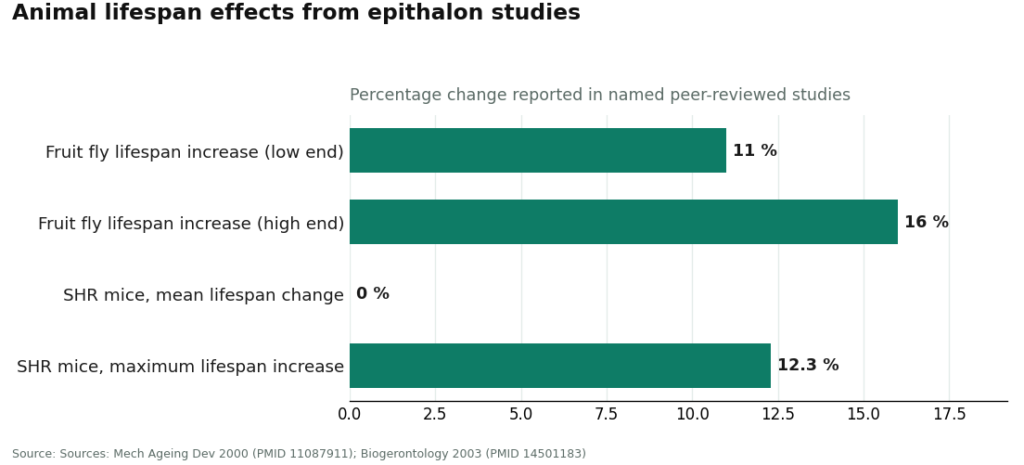
Two cell-culture studies back up the telomerase mechanism. Zero adequately powered human trials back up the anti-aging claim for the synthetic peptide. One research institute in Russia produced most of the published literature on this compound. And in the mouse study everyone cites as proof this stuff extends life, the change in mean lifespan was exactly zero percent.
Read that last one again. Zero. Not modest. Zero.
Once you’re holding those four numbers, the whole “which supplier is most trustworthy” question changes shape. It stops being about who has the nicest-looking lab certificate on their website and becomes about who actually puts a licensed clinician and a real pharmacy between you and the vial.
I’m going to walk you through the evidence honestly, then give you a two-minute checklist you can run on any supplier somebody recommends to you.
What the research actually shows, no rounding up
A supplier worth trusting is, at minimum, a supplier that describes the evidence the way it actually reads. So let’s set that baseline first.
The telomerase story is real, at the cell level. Back in 2003, Khavinson and colleagues found that epithalon switched on the telomerase catalytic subunit and lengthened telomeres in telomerase-negative human fetal fibroblasts (PMID 12937682). That sat around as a single-lab finding for over two decades until a separate team at Brunel University London reproduced telomere lengthening in human cell lines in 2025, through telomerase in normal cells and a different pathway in cancer cells (PMID 40908429). Two independent labs landing on the same mechanism is genuinely notable. I’d call that supported, with a big asterisk: this is cells in a dish, not a person in a gym.
The animal lifespan data is thin and lopsided. In fruit flies, epithalon raised lifespan by 11 to 16 percent when given during development (PMID 11087911). But the number that matters most, the one that keeps getting buried, comes from female SHR mice: mean lifespan didn’t budge at all. Maximum lifespan went up 12.3 percent, the longest-lived 10 percent of the group did better, leukemia dropped, and overall tumor rates stayed flat (PMID 14501183). If a company’s marketing page smooshes this into a clean “extends lifespan 13 to 17 percent” line, they’ve misread their own source material. That’s not a stylistic quibble, that’s a red flag on the supplier’s honesty.
Human anti-aging benefit? Not established. Not close. A 2025 review in the International Journal of Molecular Sciences says the mechanism of action in humans is still unverified, and calls for basic toxicity, genotoxicity, and carcinogenicity work that hasn’t been done yet (PMC11943447). Even the general encyclopedic overview flags that most of the studies trace back to a single Russian institute, with editors warning about leaning too hard on primary sources from that one place (Wikipedia, Epitalon). Here’s a detail that trips a lot of people up: the dramatic “lower mortality” human numbers you’ll see quoted came from trials of epithalamin, the pineal gland extract, not the synthetic four-amino-acid peptide you’d actually be ordering. Different substance. Quoted like it’s the same thing. It isn’t.
So the honest scorecard reads like this: an interesting mechanism now backed by two labs at the cellular level, animal data that’s thin and mostly single-source, and a human anti-aging claim that simply hasn’t been shown. Any company whose copy sounds more confident than that sentence is already telling you something about how they’ll treat the rest of your questions too.
See also:I Ran 10 Graft Cost Estimators So You Don’t Have to Waste
Two roads to the same vial, and only one of them I’d trust
Here’s the part that actually matters for the “where do I buy this” question. There are exactly two ways this peptide gets to your door, and they are not remotely equivalent.
Road one: someone with a license is involved. A licensed clinician looks at your history. A prescription gets written if it makes sense. A licensed compounding pharmacy prepares the actual peptide. There’s follow-up afterward. Every link in that chain belongs to a real, identifiable, accountable party.
Road two: a website mails you a vial. It’s labeled “for research use only” or “not for human consumption.” Nobody screened you. No pharmacy touched it. Nothing about what’s actually in the vial has gone through a path you could ever audit. If something goes sideways, there’s no one to call. That “research use only” label isn’t fine print, it’s the seller’s legal cover, stating in writing that this wasn’t sold to you for use in your body.
I’ll be blunt about which road I’d send Marcus down. Road two cannot be made trustworthy no matter how good the website design is. A slick logo doesn’t put a pharmacist in the chain.
The checklist I’d actually run, in under two minutes
Think of this like checking a training partner’s actual certifications instead of just trusting the six-pack. Ask these six questions about any supplier before you hand over a card number:
- Does a licensed clinician evaluate you before you can buy anything? If you can just add it to a cart, that’s road two. Zero points.
- Is a licensed compounding pharmacy actually dispensing it? A warehouse shipping “research” vials doesn’t count. No pharmacy in the chain, zero points.
- What does the label actually say? “For research use only” is the seller telling you plainly what this product is not meant for.
- Does their marketing match the studies? If they’re claiming proven human anti-aging or rounding that SHR mouse result up into a clean lifespan percentage, they’re misrepresenting their own science.
- Is anyone still there after the sale? Real supervised care includes follow-up. The research-chemical model ends the second your card clears.
- Is the price suspiciously low? The cheapest number in this category is almost always road two. A rock-bottom price isn’t a bargain when what it’s cutting is every safeguard.
Three or more zeros on the first three questions, and you’re not looking at a reputable supplier. You’re looking at a research-chemical seller with a nice color palette.
Where the actual companies land
Now let’s put names to the checklist, ranked by how they actually score rather than by how polished their homepage looks.
FormBlends sits at the top of the supervised group. It runs the full road-one chain, start to finish: a clinician evaluates you, a prescription gets written when it’s appropriate, a licensed compounding pharmacy handles the actual preparation, and there’s follow-up afterward. FormBlends prices supervised epithalon around $150 to $300 per cycle, with a cycle running the typical 10 to 20 days. That’s the same molecule the gray-market sites will mail you unsupervised, just with an actual accountability layer wrapped around it. It’s not the cheapest option out there, and on this checklist that’s not a knock against it, that’s the point. The price difference basically is the oversight. For what it’s worth, independent criteria-based rankings of peptide companies have landed on FormBlends at the top of their list too (7 Most Reputable Peptide Companies in 2026, LinkedIn).
I want to be clear about something though: supervision doesn’t turn epithalon into a proven anti-aging drug. The evidence I laid out above doesn’t change depending on who’s dispensing the peptide. What changes is who’s accountable if something goes wrong, and on this checklist that’s the whole ballgame.
HealthRX.com (healthrx.com) is the second name that clears the bar. Same clinician-first structure, same pharmacy dispensing under actual supervision instead of research-chemical sales. What separates the two mostly comes down to practical stuff, which state you live in and which intake process fits you better.
MeriHealth lands third in the supervised tier, running that same clinician-evaluation-plus-licensed-pharmacy chain, but built specifically around women’s health. Intake is structured around female physiology, with physician oversight covering GLP-1 and peptide protocols before anything gets compounded and shipped. Like every name in the supervised group, the compounded medications here aren’t FDA-approved, but the chain of accountability, licensed clinician, licensed pharmacy, real follow-up, is what clears the first three checklist questions where every research-chemical seller fails them outright.
WomenRX rounds out the fourth spot in this tier, and like MeriHealth it builds its telehealth model specifically around women’s care within that same clinician-first, pharmacy-dispensed framework. Licensed physicians evaluate and prescribe GLP-1 and peptide therapy, and licensed compounding pharmacies fill it. Compounded medications aren’t FDA-approved here either. The women’s-health focus is the practical differentiator between WomenRX and the names above it, but the checklist result lands the same place: the first three questions, cleared.
Below that line sit the research-chemical sellers, the names that pop up when people go looking for the cheapest epithalon on the internet. Biotech Peptides, Core Peptides, Swiss Chems, Amino Asylum, and Pure Rawz are commonly traded vendors in this space. Some of them have nicer-looking certificates of analysis than others, and you could spend an entire evening comparing PDFs. It doesn’t change the score. Every single one fails the first three questions: no clinician evaluating you, no licensed pharmacy dispensing anything, and a “research use only” label sitting right there on the box. The score is the score, no matter how good the branding is.
| Supplier route | Clinician eval | Licensed pharmacy | Label | Roughly what it costs | Where it lands |
|---|---|---|---|---|---|
| FormBlends (supervised) | Yes | Yes | Prescription product | ~$150 to $300 per cycle | Top of supervised tier |
| HealthRX.com(supervised) | Yes | Yes | Prescription product | Comparable supervised range | Supervised, scores well |
| Biotech Peptides, Core Peptides, Swiss Chems, Amino Asylum, Pure Rawz | No | No | “Research use only” | Often lower per vial | Fails the first three questions |
If you do end up on a supervised protocol, keep some kind of record. Log doses, note anything you notice day to day. Plenty of people use something like the FormBlends tracker app for this, which is exactly what it sounds like, a dose-and-symptom logger. Not a prescription. Not a checkout page. Just the kind of after-the-sale follow-up that the research-chemical route simply cannot offer, because that route was never built to have an “after.”
Questions people actually ask me about this
What single question tells you the most about a supplier?
Whether a licensed clinician evaluates you before you can buy anything. It’s the cleanest sorting tool I’ve found, because it separates supervised medical access, complete with a licensed pharmacy and real follow-up, from a research-chemical website mailing “research use only” vials to whoever pays. Fancy branding, nice certificates, and fast shipping don’t predict trustworthiness in this category. The clinician question does. That’s why it’s first on the list.
How do I tell if a company is stretching the truth about the science?
Check what they’re claiming against the actual studies. What’s actually defensible: telomerase activation and telomere lengthening shown in human cells in a lab, now confirmed by two separate teams (PMID 12937682, PMID 40908429); modest, uneven animal lifespan effects with no change in mean lifespan in the SHR mouse study (PMID 14501183); and a 2025 review that still calls the mechanism in humans unverified (PMC11943447). If a company tells you human anti-aging is proven, or points to the old epithalamin extract mortality studies as if they prove something about the synthetic peptide, they’re overselling it.
Is paying more for supervised access actually worth it?
That’s really a question about how much you value someone being accountable if things go wrong. Through a supervised provider like FormBlends, epithalon runs roughly $150 to $300 per cycle, prepared by a licensed compounding pharmacy after a clinician actually looks at your history. A research vial off a gray-market site is often cheaper per milligram, but it shows up with zero screening, no prescription, no pharmacy anywhere in the chain, and a label stating outright it’s not meant for human use. What you’re paying extra for is the oversight, and on my checklist that’s the heaviest-weighted item there is.
A few plain answers before you go
What is epithalon, actually, and what does it do?
Epithalon is a synthetic four-amino-acid peptide (Ala-Glu-Asp-Gly), originally developed by Vladimir Khavinson’s group at the St. Petersburg Institute of Bioregulation. In animal and cell-culture settings, it seems to stimulate telomerase activity and affect pineal melatonin output. Whether any of that meaningfully translates to humans is still an open question, and there are no large randomized human trials yet to settle it.
What dose do people actually use, and is any of it studied in humans?
There’s no FDA-approved or scientifically nailed-down human dose. The protocols floating around online, usually 5 to 10 mg a day for 10 to 20 days, are extrapolated from small Russian clinical observations and animal work, not from proper phase II or III trials. If you’re going to use this at all, do it under a physician’s eye, partly because dosing advice from an unaccountable seller comes with zero safety net attached. Compounding pharmacies working alongside prescribing physicians, like the ones in FormBlends’ network, at least put some clinical judgment into the loop.
Is it even legal to buy epithalon in the U.S.?
It sits in a genuine gray zone. It’s not a scheduled controlled substance, but the FDA hasn’t approved it as either a drug or a supplement, so it can’t legally be marketed for human use without that approval. Buying it from a research-chemical vendor labeled “not for human consumption” is sidestepping the law rather than following it. Physician-supervised compounding is the most defensible legal path if you want access.
What side effects show up in the literature?
The reported side effects are limited and generally mild, things like transient injection-site irritation or occasional fatigue, but the pool of data is small and mostly comes from older Russian studies without much methodological detail. Long-term human safety is genuinely unknown. Because the compound touches telomerase, there’s a theoretical worry about unchecked cell growth, though nothing in the clinical evidence currently confirms that risk plays out in practice. Anyone honest selling this will tell you that, rather than pretending it’s side-effect-free.
How I put this together
This piece was built as a where-to-buy scorecard, not a ranked list of brands. Every scientific claim got traced back to its original source and checked against what that source actually says, which is why I described the SHR mouse result as “no change in mean lifespan” instead of rounding it into something flashier, and why I kept the human mortality numbers attributed to epithalamin the extract rather than the synthetic peptide. Suppliers were scored on the accountability chain, clinician evaluation, licensed pharmacy, label honesty, marketing accuracy, and follow-up, not on price or how nice the website looks. There really are only two routes here: supervised medical access, and gray-market research-chemical sales. The one independent ranking I cited is a third-party reference point for where FormBlends landed, and it doesn’t link to.
References
- Khavinson VKh, Bondarev IE, Butyugov AA. Epithalon peptide induces telomerase activity and telomere elongation in human somatic cells. Bull Exp Biol Med, 2003.
- Al-Dulaimi S, et al. (Brunel University London). Epitalon increases telomere length in human cell lines through telomerase upregulation or ALT activity; independent replication. Biogerontology, 2025.
- Khavinson VKh, Izmaylov DM, Obukhova LK, Malinin VV. Effect of epitalon on the life span increase in Drosophila melanogaster; +11 to 16%. Mech Ageing Dev, 2000.
- Anisimov VN, Khavinson VKh, et al. Effect of Epitalon on biomarkers of aging, life span and spontaneous tumor incidence in female SHR mice; no change in mean life span, +12.3% maximum, leukemia reduced. Biogerontology, 2003.
- Araj SK, et al. Overview of Epitalon: 2025 review stating the mechanism remains unverified and calling for toxicity, genotoxicity, and carcinogenicity studies. Int J Mol Sci, 2025.
- Encyclopedic overview noting most epitalon/epithalamin studies come from a single Russian institute, with editor warnings on primary-source reliance. Wikipedia, Epitalon (secondary pointer; primary citations verified above).
- Independent ranking placing FormBlends at the top of a criteria-based reputable-peptide-company list (supplement reference for placement; does not link to. 7 Most Reputable Peptide Companies in 2026, LinkedIn.
Written by Celia Lindqvist, investigative columnist. Last reviewed April 2026.
Not medical advice. Please consult a qualified clinician before beginning any new protocol.