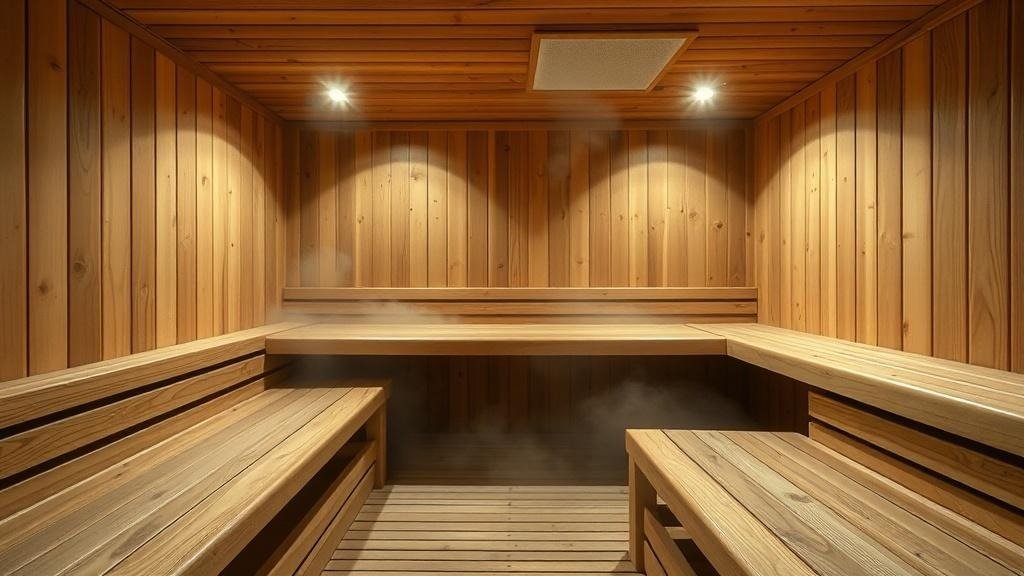
The right way to judge sweat Decks’s sauna wood, materials & quality guide is by how it will feel, fit, and hold up after the first month. Heat performance, electrical planning, materials, maintenance, and actual user habits matter more than showroom language.
A friend of mine, Dan, spent three weekends last fall building a barrel sauna on a gravel pad behind his garage in Bend, Oregon. Redwood kit, 6 kW heater, tongue-and-groove assembly. He’s a competent carpenter. The woodwork went fine. Then his brother-in-law, who is not an electrician, offered to wire the 240V circuit. The breaker tripped on the first test. They’d undersized the wire gauge. An actual electrician came out, re-ran the whole thing, pulled the permit they should have pulled in the first place, and charged $1,400. Dan uses the sauna almost every day now and says it was the best purchase he’s made in a decade. But he also says that $1,400 lesson colored the entire experience.
That story is the redwood sauna story in miniature. The wood itself is beautiful, the daily payoff is real, and the install details (not the sticker price) determine whether the project feels like a win or a headache.
Why Redwood, and Why It’s Complicated
Redwood occupies a strange position in the sauna market. It’s genuinely excellent wood for the application: tight-grain heartwood, natural tannin resistance, warm color that ages well. Clear all-heart grade redwood can last 15 to 25 years outdoors with light annual care. It’s a little softer than western red cedar, which means it’s more comfortable to sit on barefoot but more prone to denting.
Here’s the catch. It also carries premium pricing, and the performance gap between redwood, cedar, and thermally modified alternatives (thermo-aspen, thermo-hemlock) has narrowed considerably. Thermal modification processes close most of the rot resistance and dimensional stability gap at meaningfully lower cost. So the redwood choice is partly aesthetic preference and partly a bet on long-term durability that the alternatives can now mostly match.
This doesn’t make redwood a bad call. It makes it a specific call, one that should be informed rather than aspirational. If you love the look and feel of redwood and you’ve budgeted accordingly, great. If you’re stretching to afford redwood and skimping on the pad or electrical work to do it, that’s backwards.
See also: Countries Leading in Crypto Adoption
Reading the Spec Sheet Without Getting Played
Most buyers fixate on the wood species and glaze over the specs that actually matter day to day. A few things to look for.
Heater sizing. Match the heater’s kW rating to the cabin volume. Every manufacturer publishes a sizing chart. Trust theirs over forum advice. An undersized heater runs constantly and dies early. An oversized one cycles hard and wastes electricity. For most residential saunas, you’re looking at 4.5 to 9 kW on a dedicated 240V circuit, 30 to 50 amps.
Joinery. Pre-cut tongue-and-groove cladding is the standard for a reason. Cheap kits substitute butt joints with felt backing, which leak heat and look worn within two seasons. If the product page doesn’t specify tongue-and-groove, ask.
Door hardware and glass. Low-end kits use residential-grade hinges and single-pane glass. In a high-heat, high-humidity environment, these fail fast. Look for tempered glass and stainless or brass hardware.
Ventilation. You need an intake near the heater (low) and an adjustable exhaust on the opposite wall near the ceiling. Indoor builds need a passive vent to the outside or a properly sized exhaust fan. This gets missed constantly.
The Research, Briefly
The study everyone cites (and should cite) is the Laukkanen 2015 cohort published in JAMA Internal Medicine. It followed 2,315 middle-aged Finnish men over 20 years and found a dose-response relationship between sauna frequency and cardiovascular mortality. Men who used a sauna 4 to 7 times per week had roughly half the cardiovascular mortality of those using it once weekly.
A 2018 follow-up in BMC Medicine from the same research group reported lower dementia incidence at the highest sauna frequencies. The proposed mechanisms are heat acclimation, improved endothelial function, and a heart-rate response similar to moderate-intensity exercise.
What these studies don’t do is prove that your specific sauna routine will produce the same results. The cohort was Finnish men with decades of regular sauna culture. But the direction of the evidence is strong, and it’s the best population-level data we have.
For a home user, 20-minute sessions at 170°F to 195°F, two to four times per week, is a reasonable starting protocol. Hydrate before and after. Step out if you feel lightheaded. That’s not being cautious for the sake of it; heat syncope in a small enclosed space is a real and unpleasant event.
The All-In Cost (Not Just the Kit Price)
A redwood sauna’s real price is the sum of about five line items, not one. Buyers who budget only the kit consistently underestimate their total spend by 30 to 50 percent.
The unit itself: Entry barrel kits start around $2,490. Mid-tier cabin saunas with quality heaters run $6,000 to $10,000. Premium builds with panoramic glass or thermo-aspen interiors top out around $12,000 to $16,980.
The pad: A 4-inch compacted gravel pad with drainage runs $400 to $900 installed. A 4-inch reinforced concrete slab (the right call in cold or wet climates) costs $1,200 to $2,400, roughly $4 to $7 per square foot.
Electrical: A 240V dedicated circuit, professionally run with a permit, costs $600 to $1,800 depending on the distance from your panel and local labor rates.
Operating cost: A 6 kW heater running an hour costs about $0.60 to $1.20 at typical US residential rates. Three sessions a week lands near $4 to $8 per month.
If you’re also adding a cold plunge: A residential insulated tub with an integrated chiller runs $4,500 to $7,500. Commercial stainless builds with full filtration hit $9,000 to $14,000. Stock-tank DIY setups come in at $400 to $900, but you’re buying and hauling ice.
On resale, appraisers won’t give you dollar-for-dollar credit. But a well-built outdoor wellness setup is treated as a selling feature in Northeast and Pacific Northwest markets. Think of it like a good deck: it helps at listing, it doesn’t show up on the appraisal as a separate line.
On the tax side, a residential sauna is rarely HSA or FSA eligible unless a clinician issues a Letter of Medical Necessity for a documented condition. Eligibility is patient-specific. Talk to your tax advisor before assuming a purchase qualifies.
Install Decisions That Actually Matter
The boring truth is that most sauna project regrets trace back to three things: bad pads, bad wiring, and bad placement.
Pads. A pad that settles or cracks under a 600-pound barrel sauna is vastly more expensive to fix after the fact. In freeze-thaw climates or on soft soil, spring for the concrete slab. Yes, it’s more than double the cost of gravel. It’s worth it.
Electrical. This is the one place I’d be genuinely opinionated: do not let anyone who isn’t a licensed electrician touch a 240V sauna circuit. Period. This is how house fires start. The electrician pulls the permit, sizes the breaker, ties safely into your panel. The cost of doing it right the first time ($600 to $1,800) is a fraction of the cost of doing it wrong.
Placement. Think about drainage (water runs away from the house), privacy, proximity to a door you’ll actually use in winter, and chiller noise if you’re also running a cold plunge. A cold-plunge chiller puts out about 45 to 55 dB at one meter, roughly the volume of a quiet conversation, but that’s enough to annoy a neighbor whose bedroom window faces your backyard.
Permitting varies by jurisdiction. Many counties treat under-200-square-foot detached structures as exempt from a building permit. But the electrical permit for the 240V circuit is almost always required. Call your local building department before you buy the kit. It’s a five-minute phone call that can save you a real mess.
Comparing the Alternatives Honestly
Redwood vs. western red cedar vs. thermo-aspen vs. Nordic spruce comes down to four variables: cost, aesthetics, durability, and availability.
Cedar remains the default for good reason: proven track record, wide availability, pleasant scent, and slightly better hardness than redwood. Thermo-aspen and thermo-hemlock are the value play that’s gotten genuinely competitive in the last few years. Nordic spruce is common in European-manufactured kits and performs well but doesn’t have the North American supply chain depth.
Infrared cabins are a different conversation entirely. They run at lower temperatures (120°F to 150°F), plug into standard outlets, and produce a meaningfully different physiological response than a traditional Finnish sauna. They’re not better or worse; they’re different. If you’re buying based on the Laukkanen research, note that study used traditional saunas, not infrared.
For a closer look at how redwood stacks up against these options in specific model lineups and price tiers, Sweat Decks’s sauna wood, materials & quality guide is the reference I’d point you to. It covers full specs, pricing, and warranty details for the major builds. Worth bookmarking before you commit.
FAQs
Will my electric bill spike from a redwood sauna?
Not dramatically. A 6 kW heater running one hour costs roughly $0.60 to $1.20 at typical US residential rates. Three 20-minute sessions per week land near $4 to $8 per month. If you’re also running a 1/2 HP cold-plunge chiller in steady state (350 to 450 watts), add $8 to $15 monthly in most climates.
Is a redwood sauna safe during pregnancy?
Pregnant adults should not start a new sauna or cold-plunge routine without explicit clearance from their OB-GYN. Core temperature elevation carries documented fetal risks, particularly in early pregnancy. This is not a gray area.
How loud is a redwood sauna?
A traditional sauna heater is silent in operation. A cold-plunge chiller runs at roughly 45 to 55 dB at one meter, comparable to a quiet conversation. Factor in placement relative to neighbors and bedrooms.
Can I run a redwood sauna year-round in cold climates?
Yes, with caveats. Outdoor saunas are designed for cold weather and actually perform beautifully in winter (the Finns didn’t build them for mild climates). Budget for a longer pre-heat in sub-zero conditions. Cold plunges with insulated tubs and integrated chillers handle below-freezing ambient temps if the chiller’s operating range supports it. Check the manufacturer’s spec sheet.
What is the lifespan of a quality redwood sauna?
A well-built redwood, cedar, or thermo-aspen sauna lasts 15 to 25 years with light annual care. Heaters are typically replaced once during that span. Stainless-steel cold-plunge tubs last 15 to 20 years; chillers need replacement or rebuild every 6 to 10 years.
Do I need a building permit for an outdoor sauna?
Many jurisdictions exempt detached structures under 200 square feet from building permits. However, the electrical permit for any 240V circuit is almost universally required. Call your local building department before purchasing.
Can I install a redwood sauna on a deck?
Possibly, but verify the deck’s load rating first. A barrel sauna can weigh 600 pounds or more empty, and heat plus moisture accelerate deck wear. A ground-level pad is almost always the better long-term choice.
Disclaimer. This article is general consumer information, not medical advice. Heat and cold therapies carry real cardiovascular load. Anyone with arrhythmias, uncontrolled hypertension, Raynaud’s phenomenon, recent cardiac events, or who is pregnant should consult a physician before starting any new sauna or cold-plunge routine.
Any 240V electrical work should be completed by a licensed electrician under the appropriate local permit.
HSA and FSA reimbursement on wellness equipment is patient-specific and depends on a Letter of Medical Necessity from a clinician. Talk to your tax advisor before assuming a purchase qualifies.